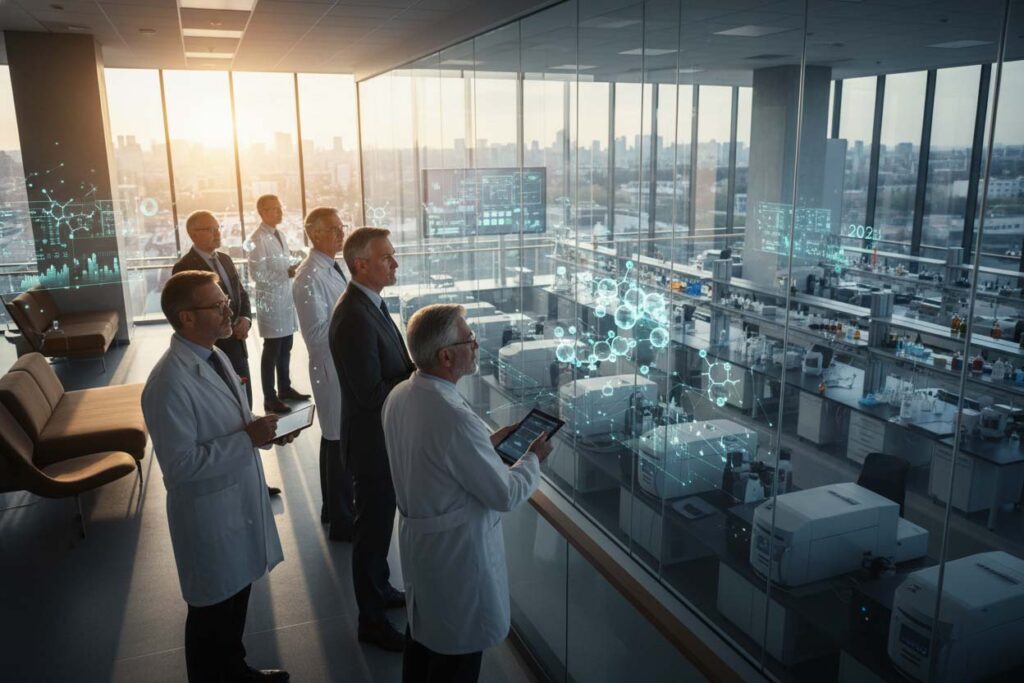

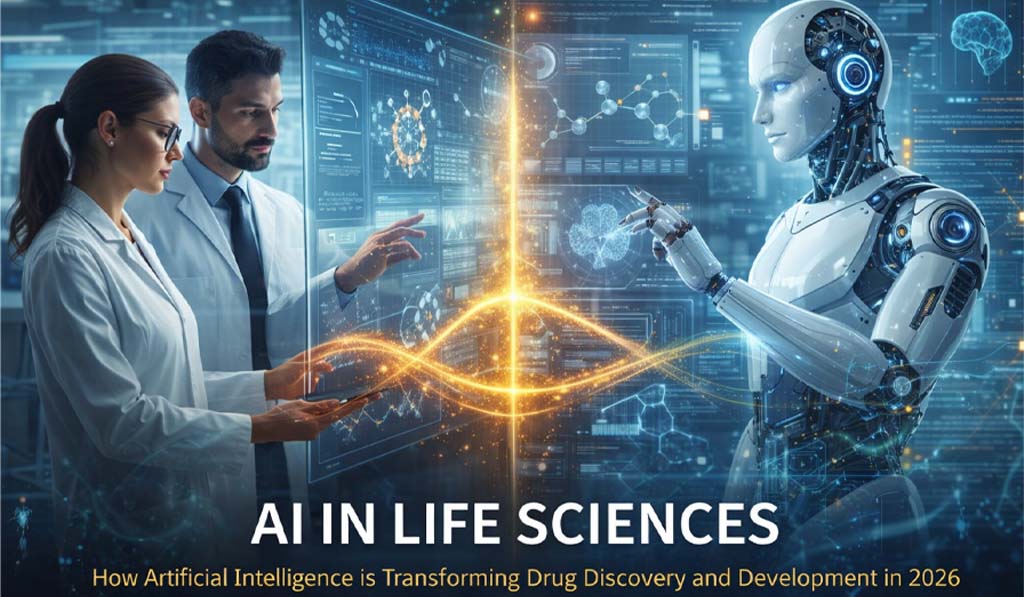







In 2026, the life sciences industry is no longer asking whether Artificial Intelligence will reshape drug discovery—it is witnessing the transformation in real time. What once took decades can now unfold within months. Laboratories are becoming smarter, data is becoming predictive, and scientific intuition is being amplified by machine intelligence.
We are entering an era where biology meets computation at unprecedented scale.
This is not just technological progress. It is a structural shift in how medicines are imagined, tested, approved, and delivered to patients.
The Moment That Redefined Drug Discovery
A decade ago, drug discovery was largely linear—hypothesis, experiment, failure, iteration and Repeat. Previously, researchers dedicated countless hours and often years merely to surmount the initial hurdles of target identification. It was a process defined by attrition rather than acceleration. Today, Artificial Intelligence in healthcare has converted this into a dynamic, learning ecosystem producing faster and smarter outcomes.
Modern AI in drug discovery platforms analyze billions of biological data points in seconds, identifying molecular relationships that even the most experienced researchers could overlook. Instead of searching for a needle in a haystack, scientists are now guided toward exact molecular coordinates. This shift does not just simplify workflows; it fundamentally optimizes operations for both individual researchers and the broader life sciences industry.
At the center of this shift is machine learning in pharma, enabling algorithms to learn continuously from genomic datasets, clinical outcomes, and real-world evidence.
The result?
Faster insights. Lower risk. Smarter investments.
And most importantly—patients receiving therapies sooner.
The ultimate game changer is patients being able to receive life saving drugs in a better and faster way. Leading pharmaceutical companies have already begun integrating AI into their drug discovery pipelines and data correlation models. This convergence of technology and biology positions 2026 as a pivotal year for advancement across the pharma and life sciences sectors.
From Data to Discovery: The New Scientific Engine
The foundation of this revolution lies in data. But data alone is powerless without interpretation.
Through big data in life sciences, organizations are integrating multi-omic datasets, electronic health records, imaging data, and biomarker intelligence into unified research environments. This convergence is powering predictive analytics in drug development, allowing researchers to forecast drug behavior before the first physical experiment begins.
Consider the emergence of deep learning for drug discovery—models capable of understanding protein folding, ligand interactions, and toxicity patterns with remarkable precision.
Complementing this is generative AI in pharma, which is redefining molecular design. Instead of screening millions of compounds, AI can now create optimized molecular structures tailored for efficacy and safety.
The paradigm has shifted from discovery to intelligent creation.
Precision Is the New Speed
Speed alone is not the ultimate metric of progress. Precision is.
With AI-powered clinical trials, patient recruitment is becoming targeted rather than probabilistic. Algorithms identify ideal patient cohorts, reducing trial delays and improving outcome reliability.
This is where personalized medicine AI is gaining remarkable traction. Treatments are increasingly designed around individual genetic profiles, ensuring higher response rates and fewer adverse effects.
Meanwhile, AI in biotechnology is enabling startups and research institutions to challenge traditional timelines, often achieving breakthroughs with significantly leaner infrastructure.
The industry is no longer dominated solely by scale—it is being redefined by intelligence.
Automation: The Silent Multiplier
Walk into a forward-looking research facility today, and you will notice something striking—not the presence of robots, but the absence of inefficiency.
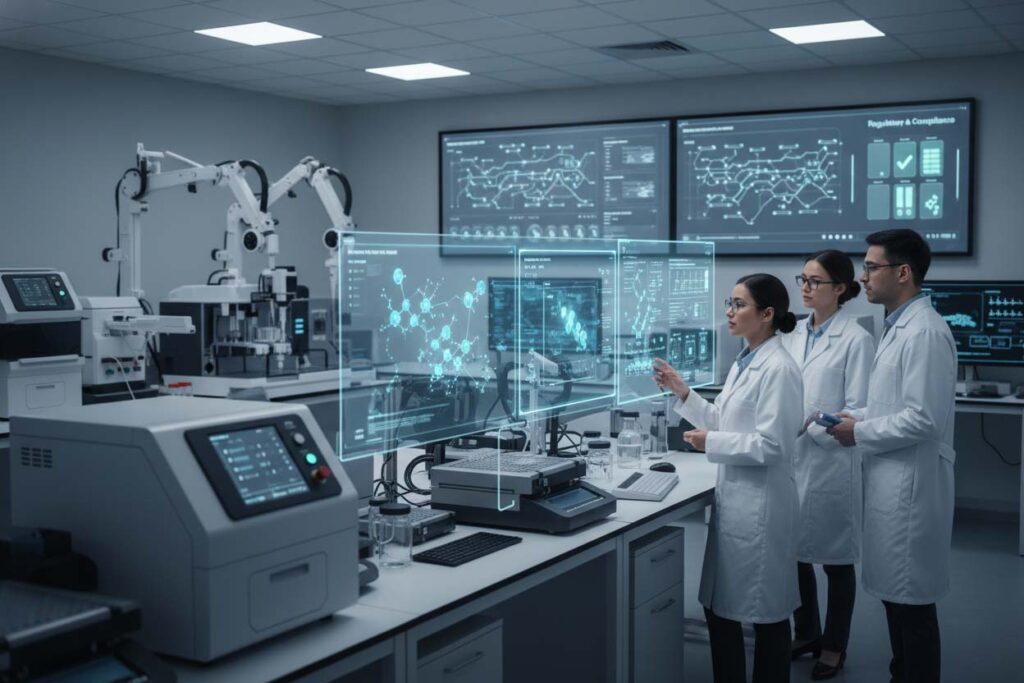
- AI in Laboratory Automation: Minimizes manual variability and improves reproducibility, freeing scientists to focus on high-value strategy rather than repetitive execution.
- AI in Drug Design: Utilizes advanced simulation tools to test thousands of scenarios virtually before a compound ever reaches the synthesis stage.
- AI in Computational Biology: Decodes complex disease pathways, accelerating therapeutic targeting for oncology, neurodegenerative disorders, and rare diseases.
- AI in Regulatory Workflow: Streamlines documentation and proactively identifies compliance gaps, significantly strengthening submission readiness.
For an industry historically defined by caution, this marks a confident step toward operational agility.
Cutting Costs Without Cutting Corners
Drug development has long been associated with billion-dollar investments. AI is beginning to rebalance that equation.
By improving candidate selection and reducing late-stage failures, AI for pharmaceutical research is directly influencing ROI across portfolios. More importantly, digital transformation in pharma is shifting organizations from reactive models to predictive enterprises.
Quality is also benefiting from this intelligence layer. Through AI in quality assurance pharma, deviations can be anticipated rather than investigated after occurrence. Similarly, AI in pharmacovigilance is enhancing drug safety by detecting subtle adverse event patterns across global datasets often before traditional systems would recognize a signal.
This is not cost-cutting.
It is cost-intelligence.
The Rise of the Self-Learning Organization
Perhaps the most profound shift is cultural.
Organizations are transitioning toward smart drug development, where platforms learn from every experiment, every protocol deviation, and every patient outcome. With cloud computing in life sciences, global teams collaborate in real time, dissolving geographical barriers to innovation.
Layered onto this infrastructure is AI-enabled drug discovery, transforming research environments into continuously improving ecosystems. Even manufacturing is evolving. AI in biomanufacturing is optimizing process parameters dynamically, improving yield while maintaining stringent GMP expectations.
The modern life sciences company is no longer just a research entity.
It is becoming an intelligent network.
The Rise of Intelligent ATMP Manufacturing in the Era of Personalized Medicine
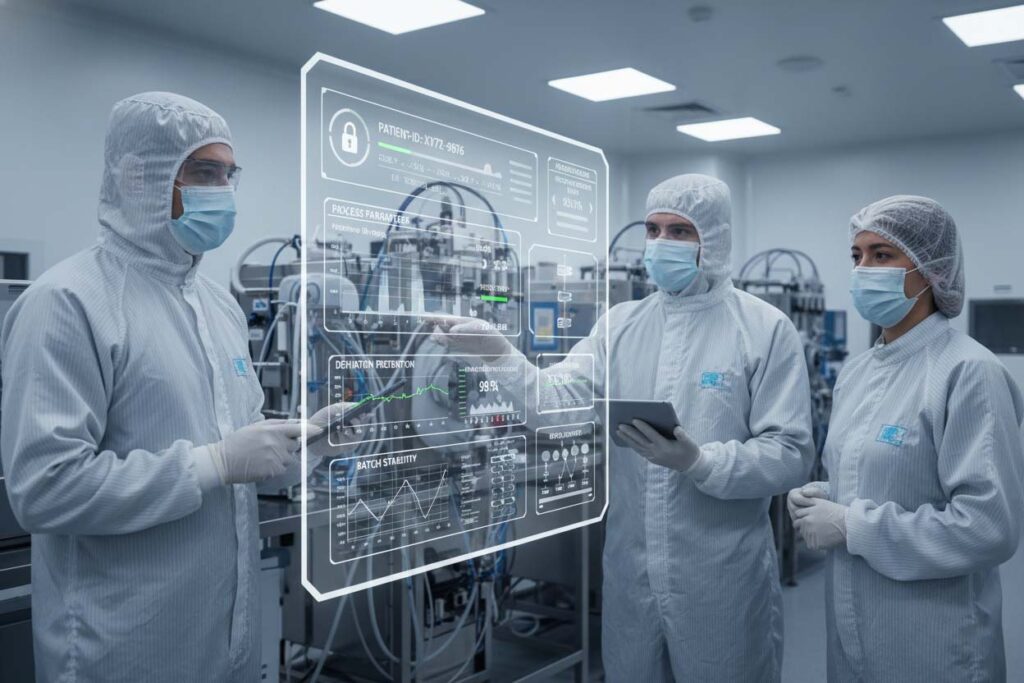
Artificial Intelligence is transforming the manufacturing of Advanced Therapy Medicinal Products (ATMPs) by bringing intelligence, automation, and predictive control into highly complex production environments.
Through AI in ATMP manufacturing and predictive analytics for bioprocessing, manufacturers can monitor critical parameters in real time, anticipate deviations, and significantly reduce batch failures. This is particularly impactful for autologous cell therapy, where each treatment is patient-specific and requires strict chain-of-identity and rapid turnaround.
Automation in cell therapy manufacturing, combined with closed-system processes and AI-enabled bioprocess optimization, is improving consistency, scalability, and GMP compliance. As a result, therapies that were once operationally challenging are becoming more commercially viable—accelerating patient access and moving personalized medicine closer to mainstream healthcare reality.
Beyond Technology: The Human Advantage
Contrary to early fears, AI, particularly in pharma is not replacing scientists—it is elevating them.
Freed from exhaustive data parsing, researchers can focus on creativity, hypothesis building, and translational thinking. The future belongs to professionals who can collaborate with intelligent systems rather than compete against them.
In this environment, leadership will be defined not by who adopts AI first, but by who integrates it most thoughtfully.
Because technology alone does not create breakthroughs.
Insight does.
What 2026 Is Teaching Us
If there is one lesson emerging clearly, it is this:
AI is no longer a competitive advantage.
It is rapidly becoming a baseline expectation.
Organizations resisting this shift risk more than operational lag—they risk scientific irrelevance.
We are approaching a world where rare diseases may find therapies faster, and oncology treatments become hyper-targeted.
Drug pipelines grow stronger with fewer uncertainties.
The distance between discovery and delivery is shrinking.
And at the center of this acceleration stands Artificial Intelligence—quietly, powerfully, and permanently reshaping life sciences.

The Road Ahead
The next frontier will not simply be faster drugs.
It will be smarter medicine.
As algorithms mature and datasets deepen, the convergence of biology and intelligence will unlock possibilities the industry once considered aspirational.
For leaders, researchers, and innovators, the question is no longer “Should we adopt AI?”
The real question is:
How boldly are we prepared to reimagine the future of drug discovery?
Because in 2026, one truth is unmistakable
The organizations that combine scientific rigor with machine intelligence will not just participate in the future of healthcare.
They will define it. They will rewrite it.